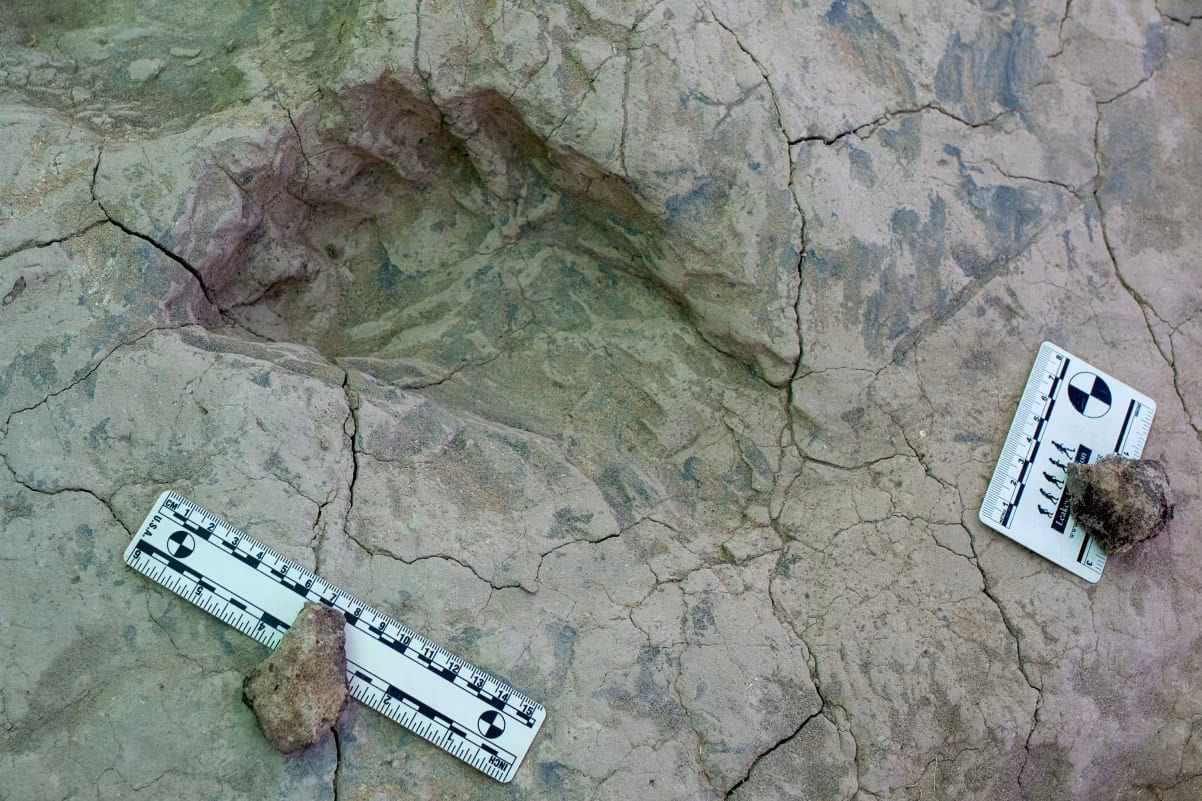
The tracks suggest Paranthropus boisei grew surprisingly large and traveled in male groups.

www.zmescience.com
Извадок:
The first fossil hominins were discovered at the
beginning of the 20th century in South Africa, just over half a century after the publication of Darwin’s milestone work
The Origin of Species (published in 1859) set the foundation for evolutionary theory based on natural selection. Since that time, the human ancestral lineage has constantly been broadened by new fossil discoveries that are progressively adding to the (still very fragmentary) picture of the long and complex family tree from which we have emerged to become the last remaining representative of the hominin line on the planet.
Among this ever-widening range of primate ancestors, the Paranthropus genus is of particular interest. Presently documented from the African continent,
at least three distinct species of Paranthropus are known to have existed for a combined period of some 1.5 million years. To put this into perspective, consider that
our own species (Homo sapiens) emerged—also in Africa—only some 300,000 years ago.
The Paranthropus were robust bipedal hominins with distinct cranial features that are believed to have supported a vegetarian diet. Their wide and flat skulls display pronounced crests and arches to buttress the heavy facial musculature required for chewing abrasive foods like plants, hard nuts, tubers, and seeds, which likely formed an important part of their dietary staple. Their powerful and protruding jaws were equipped with massive teeth in thick enamel that would have been effective for masticating fibrous plant matter and tubers. A distinctive salient sagittal crest traversing the midline area along the top of the skull maintained the heavy musculature attached to flaring cheekbones.
While the three best-known species of Paranthropus share these cranial features, studies of
dental microwear patterns observed on their teeth suggest that there may have been interspecific dietary differences and that their diet may have been more diverse and eco-dependent than previously thought.
The first South African Paranthropus specimen was identified in 1938 by Robert Broom, who provided the genus designation “
Paranthropus” to signify “beside Man” and the species’ name “
robustus,” in reference to their outstandingly robust features. This species is documented in South African sites from around 1.8 to 1.2 million years ago.
The second species is the East African Paranthropus called
P. boisei, which is known from sites in Ethiopia, Kenya, Tanzania, and Malawi, dating between 2.3 and 1.2 million years ago. The holotype specimen is a skull unearthed by Mary Leakey at
Olduvai Gorge, Tanzania, in 1959. It was initially named
Zinjanthropus boisei, with the genus name meaning “East African Human,” and the species’ name was coined in honor of Charles Boise, who funded the Leakey family’s excavations. This discovery was, at the time, the most primitive hominin ancestor ever to be discovered in East Africa.

Paranthropus was adapted for chewing, with teeth up to four times the size of a modern humans. Teeth image © S.E.Bailey, Homa Peninsula Paleoanthropology Project and model image © Tim Evanson.

This skull didn’t start out black – it was white, like all other bones in living animals. KNM-WT 17000 or the ’Black Skull’ only got its dramatic dark color after millions of years of sitting in a manganese-rich soil and absorbing minerals as it fossilized. Credit: Smithsonian Institution.